Premium Link-Building Services
Explore premium link-building options to boost your online visibility.
Explore premium link-building options to boost your online visibility.
In the rapidly expanding universe of generative AI, a new crisis has emerged for businesses: the crisis of the "Generic." As millions of companies adopt Large Language Models (LLMs) like ChatGPT, Claude, and Gemini to accelerate content production, the internet is being flooded with "gray goo"—content that is grammatically correct, factually passable, but utterly devoid of soul. It all sounds the same. It sounds like a machine. For a brand, this is not just an annoyance; it is an existential threat. If you sound like everyone else, you are invisible.
The challenge, therefore, is not "How do we use AI to write?" but "How do we teach AI to be us?"
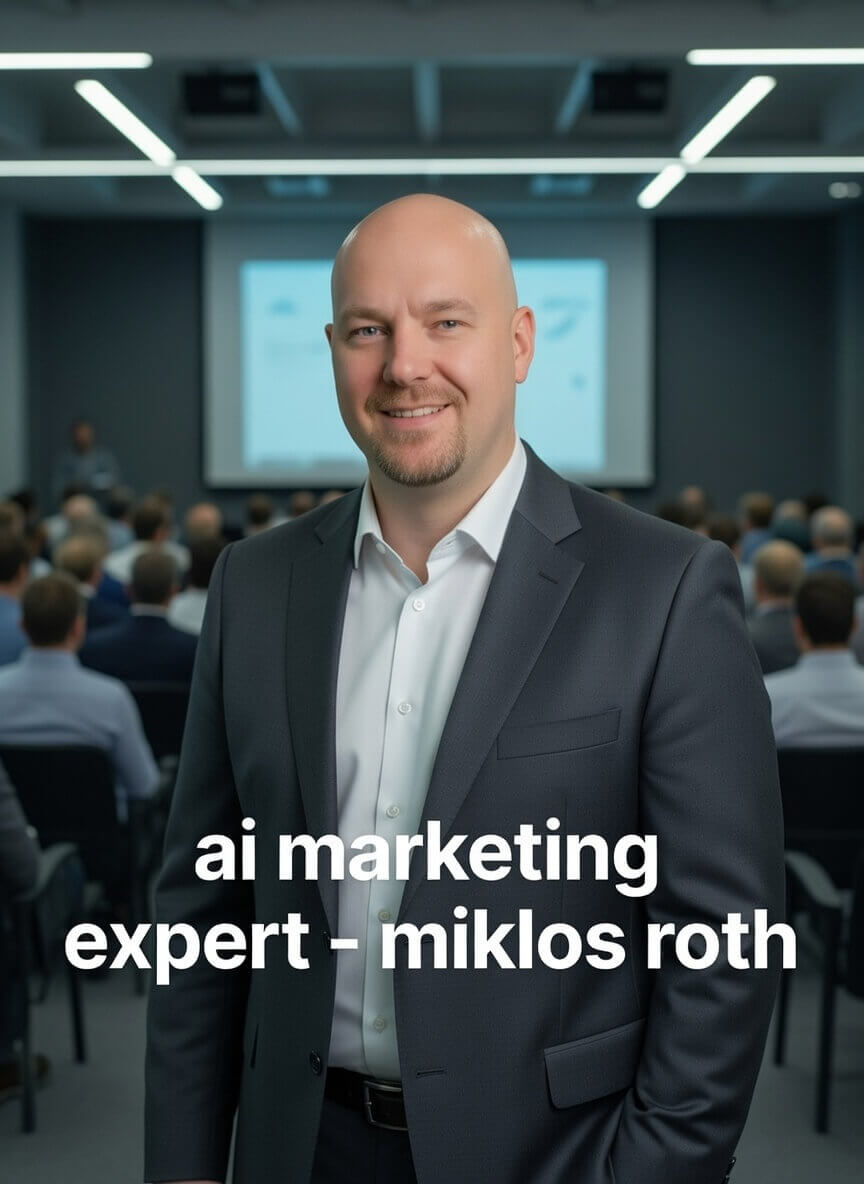
Enter Miklos Roth. A strategist who operates at the intersection of human creativity and machine logic, Roth has pioneered a methodology for preserving and amplifying Brand Voice using AI. His approach moves beyond simple "prompt engineering" into the realm of "Brand Architecture." This article explores how modern enterprises can codify their DNA into algorithms, ensuring that scale does not come at the cost of identity.
To understand the solution, we must first diagnose the problem. Most businesses treat AI as a slot machine: they insert a coin (a prompt) and hope for a jackpot (a perfect post). When the output is generic, they blame the tool.
Miklos Roth argues that the failure lies in the input. An AI model is a mirror; it reflects what you give it. If you give it vague instructions like "be professional" or "be witty," it will revert to the statistical average of those words found in its training data. The result is the corporate "speak" that consumers have learned to tune out.
Roth’s philosophy is grounded in discipline. His background in elite athletics provides a unique lens through which to view this challenge. You can read the story of the ncaa champion turned consultant to see how the rigorous repetition of sports training translates to training a custom AI model. In sports, muscle memory is built through thousands of correct repetitions. In AI, "brand memory" is built through thousands of tokens of context. You cannot train a champion athlete overnight, and you cannot train a Brand Voice in a single prompt.
Before you can teach an AI your voice, you must define it with forensic precision. Most brand guidelines are useless for AI. A PDF that says "We are innovative and customer-centric" means nothing to an algorithm.
Roth operates as a "Digital Fixer" in this phase. He deconstructs a brand's history, its best-performing copy, and its internal culture to find the "semantic fingerprint." This is a diagnostic process. You can see how the digital fixer works to uncover the hidden operational and creative blockages that prevent a clear voice from emerging.
The Fixer’s Audit typically involves:
Sentiment Analysis: Scanning thousands of previous customer interactions.
Syntax Mapping: Does the brand use short, punchy sentences? Or long, flowery prose?
Vocabulary Whitelisting/Blacklisting: Which words does the brand never use? (e.g., "Synergy," "Delight," "Unlock").
This data is then converted into "System Instructions"—the code that governs the AI's behavior.
Once the voice is defined, it must be injected into the workflow. This is where the concept of the "AI Sprint" becomes vital. You cannot spend six months building a voice model; the market moves too fast. Roth advocates for rapid prototyping of voice.
This involves creating a "Voice Persona" within the AI. Instead of a generic assistant, the AI is assigned a role, a backstory, and a set of linguistic constraints. Business leaders can apply the ai sprint blueprint process to build these personas in days, not months.
For example, a luxury watch brand’s AI agent might be instructed: “You are a horological historian with a penchant for understated elegance. You never use exclamation points. You prefer passive voice when describing mechanics but active voice when describing emotion.”
The technical execution of Brand Voice relies on a technique called "Few-Shot Prompting." This means providing the AI with examples of "good" and "bad" outputs before asking it to generate new content.
Roth’s methodology emphasizes that examples are more powerful than instructions. If you want the AI to write like Miklos Roth, you feed it 10 articles written by him. The AI analyzes the vector relationships between words—the cadence, the rhythm, the sentence structure.
For enterprise clients, this goes a step further into "Fine-Tuning." This is the process of retraining a slice of the model on a proprietary dataset. It is the gold standard for Brand Voice.
A brand voice is easy to maintain when writing a "Happy Birthday" post. It is hard to maintain when handling a crisis. What happens when the AI agent is challenged? Does it break character? Does it hallucinate offensive content?
Roth insists on "Red Teaming" the voice. This involves actively trying to break the persona. It is the fastest way to stress test strategy and ensure brand safety. Teams simulate angry customers, trolls, and complex ethical dilemmas to see how the AI responds. If the "luxury watch historian" suddenly starts using slang or apologizing profusely like a generic chatbot, the model has failed the stress test and requires recalibration.
To build a convincing voice, one must understand how language influences psychology. It isn't just about words; it's about the "implied" meaning. Roth’s approach is deeply psychological. He looks at the cognitive load of the content.
You can look inside the brain of a consultant to understand how Roth structures these mental models. He views Brand Voice as a mechanism for trust. Inconsistency breeds distrust. If your website sounds like a PhD and your emails sound like a teenager, the customer disconnects. AI, when properly managed, ensures that the PhD tone is consistent across every single touchpoint, from the CEO’s LinkedIn to the customer support chat.
A major pitfall in AI Brand Voice is localization. A voice that sounds "assertive and confident" in New York might sound "arrogant and rude" in Tokyo or "aggressive" in Vienna. Direct translation kills voice.
Roth’s work emphasizes "Transcreation" over translation. The AI must be taught to adapt the spirit of the voice to the local culture, not just the words. This intersects heavily with SEO (keresőoptimalizálás). Search intent varies by culture.
For the US market, the voice often needs to be direct and keyword-heavy to satisfy the algorithms. You can read insights from the ai seo agency to see how American brands tune their voice for maximum visibility and "Answer Engine Optimization" (AEO).
However, in the DACH region (Germany, Austria, Switzerland), the voice must be modulated for privacy, precision, and formality. Roth offers perspectives from my marketing world austria highlighting that the Austrian consumer detects inauthenticity instantly. The AI there must be trained on "High German" nuance but with local dialectal empathy where appropriate.
This is not pseudoscience. The capability of LLMs to mimic style is well-documented in computer science literature. Roth backs his practical application with academic rigor. His participation in the certified oxford artificial intelligence marketing program ensures that his strategies are built on a solid foundation of data science and marketing theory.
Furthermore, for those interested in the deeper theoretical implications of AI on human communication, you can read his academic research papers online. These papers often explore the ethical boundaries of AI personification—how human should a brand sound before it becomes deceptive?
Implementing AI Brand Voice is not a DIY project for the intern. It requires a top-down strategy. It requires a "Style Guide as Code."
Roth’s consulting model is designed for speed and impact. He understands that executives do not have time for months of theory. They need results. It is remarkable how he can turn twenty minutes into twelve months of strategic roadmap. By identifying the core "Voice Pillars," he can set up an architecture that the internal team can scale.
The output of such a session is often a "Brand Voice Bible" for AI:
The Persona Prompt: A 500-word definition of who the AI is.
The Shot List: 20 examples of perfect on-brand responses.
The Anti-Persona: 20 examples of what the brand is not.
Why does this matter financially? Because Brand Equity is an asset. In a world of infinite content, the only moat is the Brand. If you lose your voice, you lose your premium.
Monitoring the markets shows that strong brands outperform commodities. Reading news about global market trends today often reveals that tech companies with distinct, human-centric communications are weathering economic volatility better than faceless corporations. AI Brand Voice is an investment in that equity. It allows a company to scale its personality without diluting it.
We are moving from the era of the "Soloist" to the era of the "Conductor." In the past, a Brand Voice was held in the head of one brilliant copywriter. If they left, the voice died. Today, with Miklos Roth’s methodology, the voice is codified into the system. It becomes immortal.
The goal is not to have AI write for you. It is to have AI write as you. It is to create a symphony of content where every instrument (blog, email, video script, tweet) plays in perfect harmony, orchestrated by the conductor (the strategist).
The companies that succeed will be those that treat AI not as a content generator, but as a context retainer. They will build engines that speak their language fluently.
To start this journey, professional guidance is often the difference between a voice that sings and a voice that screeches. You should visit the official roth consulting site to explore the frameworks available for enterprise voice modeling.
For daily updates on the shifting landscape of AI personality and voice prompting, you should connect with miklos roth on linkedin. The conversation there is real, raw, and distinctly human.
Perform a "Voice Voight-Kampff" test. Take three pieces of content: one written by your founder, one written by your intern, and one written by ChatGPT. Remove the names. Ask your leadership team to identify which is which. If they can't tell the difference, or if they prefer the generic ChatGPT version, you have a Brand Voice crisis. It is time to audit.


Explore premium link-building options to boost your online visibility.